Editorial Links vs Directory Links: What’s the Difference?
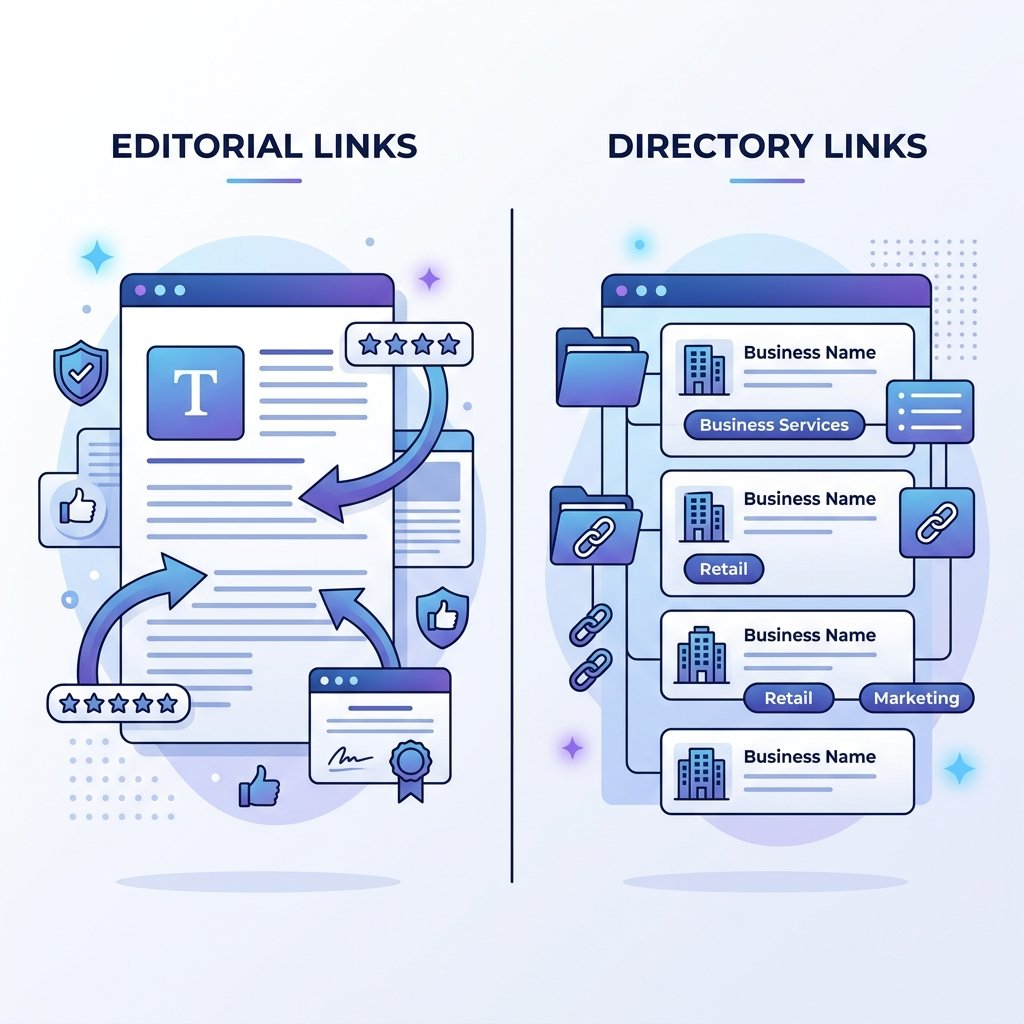
Content with editorial links is earned naturally, based on a web page that serves as a reference point for other content; whereas content with directory links has been directly added by the end users to provide online business listings. Editorial links are more valuable, factually speaking, than guest posts, but types of link have to be viewed in the context of a wider link building strategy.
If you have ever done any sort of SEO research, then the likelihood that you have come across both Editorial links and Directory links is huge. Both are a kind of backlink — that is, links to your site from another source — and both influence how search engines perceive you when laying a rank in any given space. Well, that is about where the alegance should end anyway.
It matters more than most SEO guides will tell you which of the 2 link types you choose. Choose the wrong method and buy a bunch of links that do not belong in your backlink profile, you will have only /still having/ an atrocious donkey or something that will be recieving penalization from Google. Nail it, and you get that compound domain authority going.
In this post, we will explain what editorial links and directory links are, how they differ, which is a better practice for SEO and how to build a strategy that takes both approaches smartly. The standard format of each section is a Q&A for maximum skimmability, extraction and application.
SEO Editorial Link — What is an Editorial Link
An editorial link covers a natural backlink, when a site links to your page in their writing (there was no payment or direct request for this since the linked website). These are links gained when a writer, journalist or content creator links to you because they genuinely found your content, data or expertise helpful.
Lets say you publish the study on email open rates, and magazine cites it, that citation is an editorial link for you. You didn’t ask for it. You didn’t pay for it. You earned it.
Reasons editor links are high quality backlinks
It is believed that editorial links are the holy grail of building links as they signify true third-party approval. Google algorithms using the E-E-A-T (Experience, Expertise, Authority and Trustworthiness) model place an unprecedented premium on editorially given links in 2023.
According to Google Own doc: Links have the highest value if the linking site links to it, not algorithmically by some robot that recommends it and goes along with the relevance of a few terms you queried your research for your content studies. By definition, links in the editorial space make it this term.
Many of the characteristics of editorial links are as follows:
Contextual ads: These are shown in a larger segment of relevant content and buffered by topical text.
High domain authority sources: Editorial links are found in news outlets, niche publications or established blogs.
Unlike an agreement-given anchor text: natural anchor text is the one that reflects what linking author picked up naturally.
Not exchanging or paid links: These are not reciprocal links, purchased or included in a link scheme
How Editorial Links is Acquired?
The easy answer here is that any element that earns editorial (not paid) links offers something worth referencing or building off of. Common formats include:
References: Studies, statistics and other research wants to quote.
Long guides and explainers: The rich resources you bookmark to come back to again and again in any given niche
Industry Trends: Commentaries, quotes, articles from credible voices in an industry
Use case 1: Infographics & Visual data Assets to share, that publication can embed with a credit hyperlink
Calculators & Tools:Resources that are usable and shared by bloggers/journalists with their audience
What Are Directory Links?
Link to Directory: SEO, Search and the Search Engine Open Results Pages
One type of backlink is called directory link. It is when you get a backlink after submitting your website to an online directory, which is known as a listing platform that organizes businesses, websites or other resources by topic (industry) or location.
Unlike editorial links which are placed reactively, directory links are proactively placed. But you choose the directory, complete some details and receive a link back to your site. And some of these directories can be submitted free or paid submission / listing fee.
Examples of online directories include:
So, directory links generally account for different sorts of platforms:
Primary directories:Google Business Profile, Yelp, Yellow Pages and Foursquare
Industry specific directories i.e. for agencies: Clutch (agreeable), lawyers — Avvo (accountability) and Healthgrades (mediating deals!) typically serving medical professionals
Local directories: Chamber of commerce, business listings by municipality
Niche link directories: they consist of curated lists of tools, blogs or resources in a specific space.
Not all are equal, some of them do seem to carry natural directory links.
No—directory link quality varies significantly. What this means is that link to a high-quality, human-edited directory with strict editorial guidelines(such as DMOZ before it was closed or any other reliable industry organization) has way more SEO power than a listing in some auto-generation low-quality dark-figure directory that accepts anything that they are sent.
The four most powerful aspects of quality for directory links are: domain authority, niche relevance, moderation standards and on or off page linked (dofollow vs nofollow).
What Is The Different In Editorial Links And Directory Links?
SEO Basics: What are Editorial Links and Directory Links
The distinctions between these kinds of links extends into nearly every area of quality in linking. Here’s how they stack up:
Source and intention: Editorial links are created by publishing content. Links directories are is the ones that you submit manually.
SEO potency: Editorial links seldom reflect a lower PageRank value; rather, they are among the most potent links available in your arsenal because their presence is an implicit endorsement of intelligence. They can be anything from high-quality directories that give genuine details to other, more borderline directories that offer almost no valuable information at all.
Contextual relevance: Editorial links are included in relevant content that reinforces topical authority. You are linked to directories, which exist in general category listings at best offer a fair degree of topical relevance.
Scalability — Generating directory links in a large volume is no challenge for any of us. What this means is that it becomes harder to gain editorial links at scale because this style of link-building requires continuous investment in content and outreach.
Risk profile: Next links from paid or spammy directories go against Google spam policy. As for honest editorial links, there is practically no risk at all.
Control of anchor text with editorial links Anchor text is a decision of the linking author. And for directories, the submission controls anchor text (but be careful not to over-optimize).
Editorial links are better for search rankings than directory
The bottom line is that, if all we care about is ranking power, editorial links are nearly always a better bet than directory links. Google’s Penguin algorithm update (additionally incorporating itself into Google’s core algorithm) a group of abusive link schemes most of which were low-quality directories starting in 2012. In fact, organic editorial links have only become more comparatively valuable since then.
But it not precisely fair to frame all this as an either/or: The ideal backlink profile is a combination of the two.
Directory links contribute to:
Local SEO: Directories like Google Business Profile and Yelp directly influence local search.
NAP consistency: Running NAP checks means that you can be beneficially strong when put to the validation test by local authorities.
Referral search traffic → visitors not just link equity → live only directories
One aspect of this that you might be confused about is how exactly do industry directories fit into the mix to help with overall lead generation, right?
Editorial links contribute to:
Boosting the authority of your entire site: Well-placed editorial links enhance domain authority, helping boost rankings for content across your domain
Topical authority: Links from four or more different domains that are relevant and properly targeted help to indicate your topical authority on a given subject.
Algorithm Instinct — Google spends an enormous amount of energy to build systems that will give links to sites that people deserve and not the ones they buy.
Do I need to stop mostly requesting editorial links and request more directory type?
If you are primarily trying to raise prices in organic ratings, especially if there is a lot of competition for keywords, then use Editorial links. Buy link building on your editorial takes the form of compound interest—support new content rankings faster and more easily as you build domain authority.
If you are creating a new brand online, trying to gain local search traffic or if you work in an industry where the directory actually sends people who are looking to use your services(basically anything legit; legal, medical, home services etc.) concentrate on directories.
How to Earn Editorial Links
How can you get links from editorial level?
If you want editorial links, it is necessary to get some kind of resourceful content that will be cited in different articles, press releases and other external sites. Some common successful strategies include:
Get exclusive data: Perform research, create your own surveys / proprietary dataset analysis or aggregate statistics from verticals Data backed content is the most referenced type of content in almost any niche.
Build Linkable Assets: Create a free tool, template or calculator that bloggers and journalists want to link to.
Digital PR Assistant — Work with Data Standpoint → Pitch story angles, data analysis and expert commentary pieces to journalists/publications. HARO (Help a Reporter Out), now also branded as Connectively that pairs sources with reporters seeking expert insight.
Guest posting on high authority sites — Writing an article for reputable media in the industry gives you a mention with context and (if allowed) with a link back to your site.
The Skyscraper technique – search for top-ranked pages in a niche, improve upon it, reach out to sites linking to the original and pitch them your more useful piece.
Utilizing public relations to uncover broken links on sites where you would like to have your content and then getting linked, known as broken link building.
Merit is the singular denominator weaves itself throughout all these strategies. Editorial here prioritizes quality over link shortcuts.
Leveraging Directory Links
How do you build links with directories without jeopardizing your SEO?
Note that not every directory link building is going to be equally effective. Done poorly, it wastes time. If you do so poorly, it can hurt your backlink profile. Now, this is what to do strategically:
List with relevant directories — only elevate your listing with related to the industry or area of interest directory. The addition of a matrimonial directory for a cybersecurity company — just looks like rent-seeking, which is value destroying.
Focus on high authority directories: Focus on majority used and well-moderated directories. When you submit to any given directory, always check the domain authority of that listing — anything over 40 approach with caution.
In Local SEO it is a must that every directory has exactly the same copy of your name, address and phone number i.e. NAP consistency (name, address, phone number — see: the reference paper electronic text). This confuses search engines, and weakens local ranking signals.
Stay away from link Farms and paid schemes: A lot of those websites that connect you with hundreds of business directories in a few days have links that are worth nothing for your ranking, not to say they are really dangerous.
Watch all of your listings: Info from directories can have outdated information. Regularly check your listings for accuracy
A comparative analysis between editorial and directory links
| Factor | Editorial Links | Directory Links |
| Acquisition method | Earned organically | Manually submitted |
| SEO value | High | Low to moderate |
| Difficulty to acquire | High | Low |
| Anchor text control | None (chosen by author) | Full control |
| Topical relevance | High (contextual) | Moderate (categorical) |
| Risk of penalty | Very low | Low to moderate |
| Best use case | Authority building, rankings | Local SEO, brand visibility |
| Cost | Time and content investment | Free to paid |
Frequently Asked Questions (FAQ)
Q: What is a distinguishing difference between an editorial link and a directory link?
This is what we refer to as an editorial link, where your site is referenced in the text of another site. When you submit your website to an online listing platform, the directory link is then entered manually. Editorial mentions therefore often have more SEO value, as they can highlight organic editorial backing.
Q: In 2024, are directory links still good for SEO?
Yes, directory links remain good for SEO (as well as local search rankings & branding) just the efficiency of them depends on the directory. A Good Quality Niche Directory Gives You Real Value 1. Unless, of course, we are talking about not good quality and spammy directories that can ruin your link building profile.
Q: Do Listing Links harm my SEO?
Yes. However, after Penguin anyone those submitting to irrelevant or low quality directories and paid link directories, may give the spammers a heads up already on Google’s hit list. Avoid using mass directory submission service and rather opt for only high authority, editor-reviewed directories.
Q : How Many Directory Backlink Required?
Now we have a number to shoot for but there is no single target number that everyone should hit. Focus on Quality Over Quantity — A handful of listings on trusted, topically relevant directories are better than dozens of listings on junk sites with low authority. This provides local businesses a good (but not comprehensive) starting place of the big directories (Google Business Profile, Bing Places, Yelp and vertical-specific sites).
Q: For how long do you work on editorial links?
Link building for editorial content is a marathon. Link-building assets, digital PR campaigns and relationships via publishers take months to generate predictable results. But the majority of SEO Peers tend to recommend that it should be regarded as a long term investment rather than just a campaign.
Q: Editorial links: are they always dofollow?
Not necessarily. There are some publications that will always add nofollow or sponsored to outgoing links as a matter of editorial policy. While dofollow links transfer PageRank more directly, nofollow editorial Links from authoritative domains are still valuable when it comes to brand credibility and attracting relevant referral traffic.
So, what is indeed the fastest way to attain editorial links? — Conclusion
Digital PR is near enough always the quickest route to editorial links. And if you are looking for links from publication relevant to your news, you can put a link to high-authority new sources breaking industry-making trends within days. HARO, or what is now known as Connectively, is the biggest go-to service with journalists hunting for expert sources.
Build Backlink Profile That Works
Directory is not competing strategy with editorial link building — they are companion tools and have different goals for various stages of your SEO evolution.
The quickest win for an early stage websites is typically to go the route of creating directory listings in order to begin building a local presence and overall trust within your brand. The initial stages as a new site, not sufficient content and hence building around the quality of those pages over time, thus editorial link building now your number one lever in gaining authority – Win the battle against competitors for top spots.
The take away IRL: Build a list of your backlinks, research what you have in each category and make a plan to obtain links from both types. Clean your local citations (If there are any inconsistencies) Purchase citation-worthy assets If you are not acquiring organic backlinks with regards to the content
SEO likes sites that are useful, respected and trusted by others in the same area. It does make for a careful blend of editorial and directory links that displays all three of them to you.
Also Read: White Hat Link Building, SEO Strategies That Work Long-Term