13 Common Link Building Myths Explained (SEO Q&A Guide)
Link building is still part of Search Engine Optimization (SEO).. It is also the misunderstood. As search engines use advanced Artificial Intelligence (AI) to look at the web old ways of building links have not become outdated—they have become dangerous.
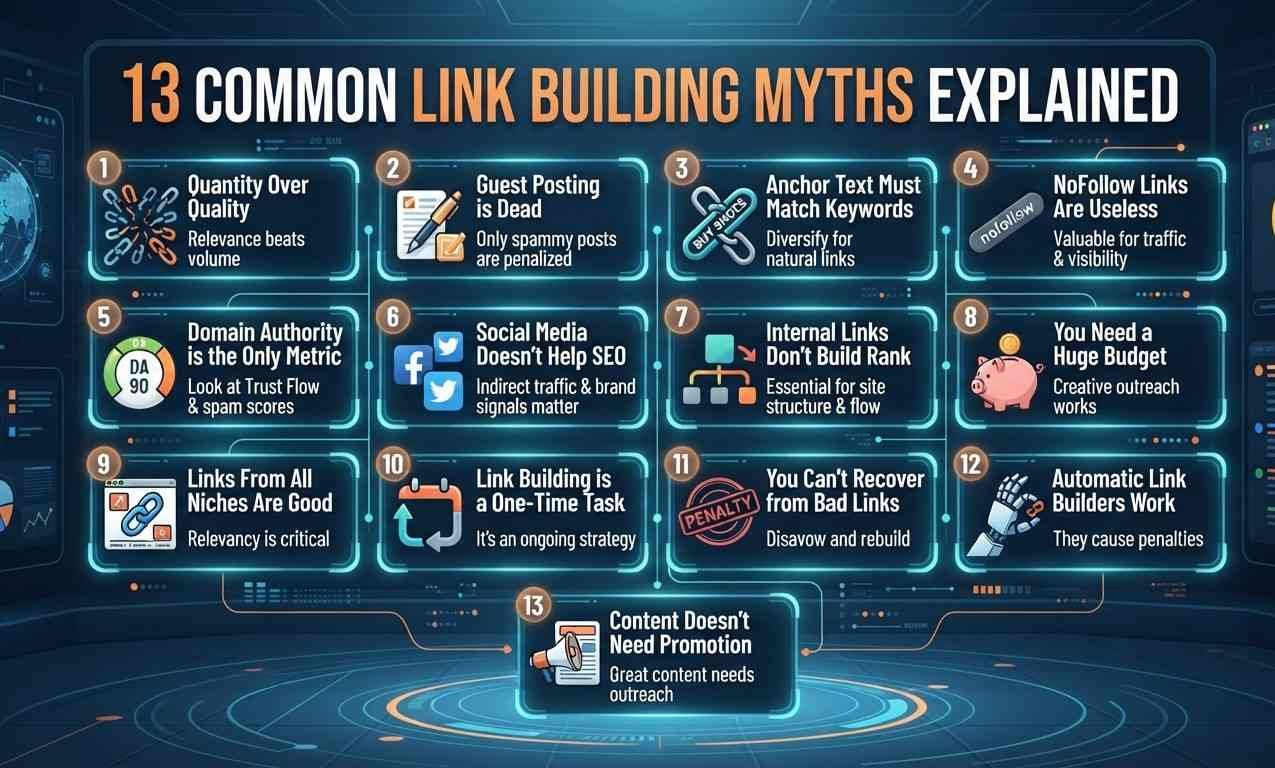
This complete Q&A guide breaks down 13 of the link-building myths and explains exactly how modern AI search algorithms rank your backlink profile.
Q1: Is link building dead because of AI search?
A: No. Link building is not dead. It has changed. AI search algorithms (like Google’s parts powered by machine learning) still use backlinks as a signal of trust, authority and relevance. Links act like votes of confidence from others. While AI can understand content better than before it still uses the web’s network (links) to find which verified sources are trusted by authority websites.
Q2: Do more links always mean rankings?
A: No. Quality is more important than quantity. Getting 5 backlinks from relevant industry publications will help more than getting 500 low-quality links from automated directories or spammy forums. In fact, a sudden spike in low-quality links can reason filters or manual penalties.
Q3: Should I only focus on getting “DoFollow” links?
A: No. While DoFollow links pass PageRank, a real backlink profile always has a mix of NoFollow, Sponsored and UGC (User Generated Content) tags. Search engines use NoFollow tags as hints. If your website only has DoFollow links it seems fake. Manipulated to AI spam detection systems.
Q4: Does exact-match anchor text build the rankings?
A: No. Relying much on exact-match anchor text (like forcing every link to say ” cheap running shoes”) is old school. Modern search AI looks at the text around the link. Over-optimizing your anchor text is a sign of link manipulation. Try to use a mix of branded, URLs and everyday phrases.
Q5: Are blogging links no effective?
A: It depends on how you do it. Standard, automated low-quality guest blogging for a keyword-stuffed link bio is. Gets penalized. However publishing quality research or expert insights as a guest author on a real popular industry site is still a strong way to get authoritative links.
Q6: Can I just buy links safely if they look natural?
A: No. Buying links is against search engine rules. Search AI has been trained on amounts of known link networks paid link patterns and sudden link spikes. While paid links might help for a time AI systems eventually find the pattern leading to a drop in visibility.
Q7: Does a high Domain Authority (DA) guarantee a link?
A: No. Third-party scores like Domain Authority (DA) or Domain Rating (DR) are calculated by SEO tools, not by search engines. These scores can be made higher by spammers. A link from a DA 30 website that’s very relevant to your niche is better than a link from a DA 70 site that has random unrelated content.
Q8: Will getting a link from a site in a niche hurt my SEO?
A: Not exactly. Relevance matters. If a local bakery gets a link from a tech blog because the bakery made a cake for a tech product launch that link is natural and valuable. However if that same bakery gets links from real estate or gambling sites it looks like manipulation. Relevance is checked at the page level, not the site level.
Q9: Does a link from a website have no value?
A: No. Every authority site started as a site. If you get a link from a high-quality startup or a rising blog that gets user engagement that link will grow in value as the website becomes more popular.
Q10: Are links important than external backlinks?
A: That is a mistake. Internal link building is entirely up to you. Is very powerful. Internal links share “link juice” (PageRank) across your pages set up your site’s structure and help search AI understand how your content is connected.
Q11: If I lose a few backlinks will my rankings drop away?
A: Usually no. The web is always changing; links break pages get. Sites change. Search engines expect some loss and gain of links. Your rankings will only have a problem if you lose important high-authority links at once or if you stop getting new links completely.
Q12: Can competitor SEO (spam links) easily hurt my site?
A: No. Modern search algorithms are very good at finding automated SEO attacks. Of punishing your site for a flood of bad links AI filters usually just ignore them making the attack harmless.
Q13: Is link building a one-time task?
A: No. Link building is a process. Because your competitors are always getting links staying still means you fall behind. Good SEO needs a flow of fresh authoritative mentions to show search AI that your website is still relevant and trusted.
How Search AI Ranks and Evaluates Link Profiles
Modern search AI does not just count the number of links pointing to a page. Instead it looks at your link profile through deep learning layers that focus on three areas:
[Link Evaluation AI Engine]
├──► 1. Contextual Semantics (Text around the link and page purpose)
├──► 2. Trust and Source Quality (Proximity to trusted sites)
└─► 3. Growth (Pattern of real human growth)
- Contextual Semantics: AI models look at the text next to the link (the paragraph around it). It checks if the topic of the source page connects logically to the topic of the destination page. If the connection is weak the link has weight.
- The “TrustGraph” Method: Search engines use a group of trusted websites (like universities, government sites and major media). The closer your website is in the link graph to these trusted sites ( steps the higher your trust rating.
- User Interaction Signals: AI watches how people use links. A link that is naturally placed in an article and people click on it has more value than a link hidden in a footer that no one touches.
Frequently Asked Questions (FAQs)
What is the best way to build links now?
The safest way is PR. Create useful content. Make high-value content—like research, data studies, free tools or detailed infographics—that industry journalists and bloggers want to use as a source.
How long does it take for a new backlink to affect rankings?
It can take between a days and several weeks. The search AI needs to recrawl the page with your link check the meaning around it. Then update the weight across the web.
Should I manually remove low-quality links?
According to search rules you only need to use the Google Disavow Tool if you have a penalty or if you have a system-wide problem with spam links you caused (like from a bad SEO company). For spam the AI ignores it automatically.
What is the best mix of branded vs. Keyword anchor text?
There is no mix. A natural profile usually has over 60-70% branded anchors (your company name) naked URLs or general phrases like “click here ” with keyword-targeted anchors being much smaller and more targeted.
To make this article better for your needs please let me know:
🔗 Social Media Signals and Modern Link Building
Social media signals (shares, likes, tweets and engagement) do not pass PageRank or link value. However they help search AI. Check your links.
Yes social media signals are very important because:
- Fast Discovery: A post that goes viral on LinkedIn or X (Twitter) is crawled faster by search engine bots.
- Amplification: Content that gets a lot of interaction gets seen by bloggers, journalists, and webmasters. These people are the ones who will eventually write articles and give you high-authority backlinks.
- Brand Trust: Modern search AI uses social media activity to check that your brand is real active and has people interacting, not a site made for SEO.
🚀 Final Summary Checklist: AI-Ready Link Building
| Strategy Factor | ❌ NO (Avoid It) | YES (Focus Here) |
| Content Creation | Mass-producing short, generic blog posts. | Publishing original industry data and case studies. |
| Outreach Process | Blasting hundreds of websites with automated email templates. | Building genuine relationships with marketing editors. |
| Social Integration | Leaving your content to sit silently on your blog. | Actively distributing insights across LinkedIn and X. |
| Success Metrics | Chasing arbitrary third-party metric scores (DA/DR). | Measuring referral traffic and contextual industry trust. |